Sunday, August 22, 2010

Sometimes you just got what you got

I'm pretty slow sometimes but processing this image of M33 taught me something.  You can spend as much time as you want processing an image hoping to stumble across some arcane photoshop command-alt-clickery that will extract ever fainter photons that just aren't there.  Yeah, sometimes you just got what you got.  Be satisfied.

I learned a lot this time around.  Blue-Red channel trickery to kill the green weenie.  Color halo reduction. All kinds mask selection/load/subtract-ery.  Good stuff - and absolutely no way to reproduce how I got to the endpoint.  However ... I am repeating to myself ... be satisfied.

At 200mm the image scale for M33 isn't all that great.  At least compared to M32.  It's smaller than I remembered :).   I was also a bit surprised that 60 min didn't pull out more.  A late rising moon just below Kitchen Mesa accounts for the still persistent gradient in the lower right corner.  The presentation could be improved but dear reader ... there simply ain't no mo' photons.  I give you all I have.

You know what?  I'm satisfied.  Mostly :)    Hanging up the hair-shirt for a bit before I tackle another set of data from the New Mexico trip.  Click for larger image.

M33  Macbook Pro 15 center crop


Taken at Ghost Ranch near Abiquiu,  New Mexico August 6th, 2010

Canon T2i (stock), 200mm EF-L @ f2.8
Astrotrac Travel System mount
Imaging temperature range:  52-54F
60 60sec exposures @ ISO3200
64 darks,  21 flats (1/5" ISO 100) 21 flatdarks
pre-processed and stacked in Nebulosity
post-processed in PS4

Sunday, August 15, 2010

M31 ... now in Color!

I spent a couple, a few  5 hours today trying to get a handle on the color image of M31.  First I had to figure out the best settings in Nebulosity for the debayer step.  There are no default settings for the T2i - the camera is still rather new.  While I could have chosen just about any setting and done the color correcting later (in Nebulosity or PS) my previous attempts were rather garish.

To get a handle on this I took a RAW picture outside in sunlight that included a gray card.  Verified in PS that the RGB values were the same (check).  Then I opened the file in Nebulosity and debayered with every setting possible (hair shirt?  check).  Then I wrote down the RGB values reported by Nebulosity for the same spot on the nominally gray card and selected the conversion profile that gave the "most gray" (equal RGB) values (double hair shirt, check).

Next I proceeded to reprocess all the images with the new setting.  Which, by the way if you are reading this and happen to be in same situation and don't want to spend 2 hours going through the exercise the answer is ... ta-da ... straight color scaling (not a specific camera like stock 40D or unmodded 300D or whatever).

After all that I cropped and did a Auto Color Balance.  Saved every file en route.  Then I post processed the image in Nebulosity.  The spirit was willing but the body was too weak to start postproc in Photoshop.

The image is still too pale, greenish bluish or something.  And I have orange star halos, some noise to bang down and so on.  After some well deserved rest I'll tackle the image again in Photoshop to see what I can do about color issues.  In some sense I like the more muted colors.  Going forward I'll have to think about how I will use colors in these images.  But, for now, here is M31 in all it's Ghost Ranch glory.

As for all images ... click to see a larger version.
M31 processed entirely in Nebulosity


Taken at Ghost Ranch near Abiquiu,  New Mexico August 4th and 5th, 2010
Canon T2i (stock), 200mm EF-L @ f2.8
Astrotrac Travel System mount
Imaging temperature range:  52-58F
87 60sec exposures @ ISO3200  (taken over two evenings)
64 darks,  21 flats (1/5" ISO 100) 21 flatdarks (still not sure about needing these)
pre and post-processed in Nebulosity

Drive that Spike

Remember that post about making the bobby pin Bahtinov mask ... the "Happy Face"?  I ended up using it only once.  Well, there was only one night worth using it but that is beside the matter.  On *that* night I wanted everything to be as good as I could make it so I figured since I spent so much time making the blasted thing I might as well use it.

Focusing is a hard.  Like real hard.  Especially with a short focal length camera lens at wide open f-ratio. The slightest touch of the focus ring (no - autofocus doesn't work - too dark even on a bright star) is enough to make your stars look like they have had nothing but Micky Dees super-sized combo meals for a month.  That and surrounded by halos of all colors.  Bah!

For this trip I mostly just used live view on the Canon back mag'd up to 10x and tried to make the stars as tiny as possible.  Worked well enough for the conditions.

Here I took a picture at ISO3200 for 5 sec then reviewed on the camera back (blown up 10x) and by the tiniest touches tried to get that middle spike in between the X.  Back and forth.  Nudge, shoot, review, nudge, shoot, review (say naughty word), nudge, shoot, review (say naughty word), nudge ... you get the picture.  I kept the last picture, said "good enough", resisted the temptation to touch focus again without the mask and carried on with imaging.

Handy tip ... remove Bahtinov mask before imaging run.  Yeah.  Wouldn't that be something.

Fortunately I had to frame my shot with test exposures and noticed the stars were all dim and funny looking.  Yikes.
Center the Spike!  Bahtinov focus on 200mm Canon EF-L at f/2.8

I only just now thought to take a look at that image under the light of day.  Much easier to see on the computer screen than while on your knees craning your neck to see the camera back.  Looks pretty good - just a touch off - but it would have taken luck to place that spike any better.  The only way would be to use a fine motion focus ring attachment - something I have been working on.  More on that another day.

I'm happy with the focus on the Andromeda shot - don't really think I could have gotten it any closer.  The Bahtinov mask is cool and a real savior for those imaging with telescopes.  I'm not sure it is of much help with 200mm or smaller camera lenses, but it was fun to make while the storms rolled by.

Friday, August 13, 2010

The Abscence of Color

It would appear the imagers job is never done.  All images are a "work in progress".   You just know you can add some more data ... process a little more ... learn some secret dark art that will make the image pop.  I'm not immune.

Friend(s): "So!  Did you get any pictures of the sky?"

Me: "Ah, yeah, a few.  But there were clouds ... had one good night ... will take me a while to process them"

Friends(s):  (losing interest quickly) "oh, ok ... let me see something when they are done then".

What they don't realize is they will *never* be done!   sigh.  So in order to combat this illusion of progress through motion I will post up what is likely the only good image from the trip ... in B&W.  I gray-scaled the image because I am having a nasty time trying to get the colors figured out.  All RBG debayering channel sensitivity hoo-ha.  Really starting to get me PO'd.


M31, M32, M110  (Andromeda galaxy and companion elliptical galaxies)

Canon T2i, 200mm EF-L @ f2.8
Astrotrak Travel System mount
87 60sec exposures @ ISO3200  (taken over two evenings)
64 darks,  21 flats (1/5" ISO 100) 21 flatdarks (still not sure about needing these)
preprocessed in Nebulosity
post processed PS4

Color will follow when/if I get that figured out.  Just hate throwing away all *that* data.

Sunday, August 8, 2010

Expectation Management

hmmmm ... now that didn't quite go as anticipated.  I look at the date of the last post and it was a full 8 days ago.  Storms, aging hardware and people not quite so sure how to cycle a router (or if they should even trust a guy who looks like he just wandered in from the outback to do it) all conspired to keep me off the net.

So here it is a full week later and we have arrived back home.  Home where the signal is strong and bandwidth abundant.  Somehow the trade doesn't seem even.

No, my heart is still on that mesa.  Sitting on a cold folding chair, my tracking mount and camera ready for any break in the clouds.  Hours out there.  Everyone else asleep.  Hour after frustrating hour.

I loved every minute of it.

I was talking to a woman while waiting in line for lunch a few days ago.  She was relaying her disappointment of a hike canceled due to lightning but instead she got to spend a few hours connecting and talking with her grand daughter while watching the weather pass.  Understanding, I told her that Ghost Ranch is all about "expectation management".  She said "oh, I have the remember that ..." and pulled out a pen and began scribbling in a notepad.  Having someone write down something I say at a place where world famous writers, poets and artists hang out was amusing to say the least.  But the more I thought about it the more I could see it for myself.

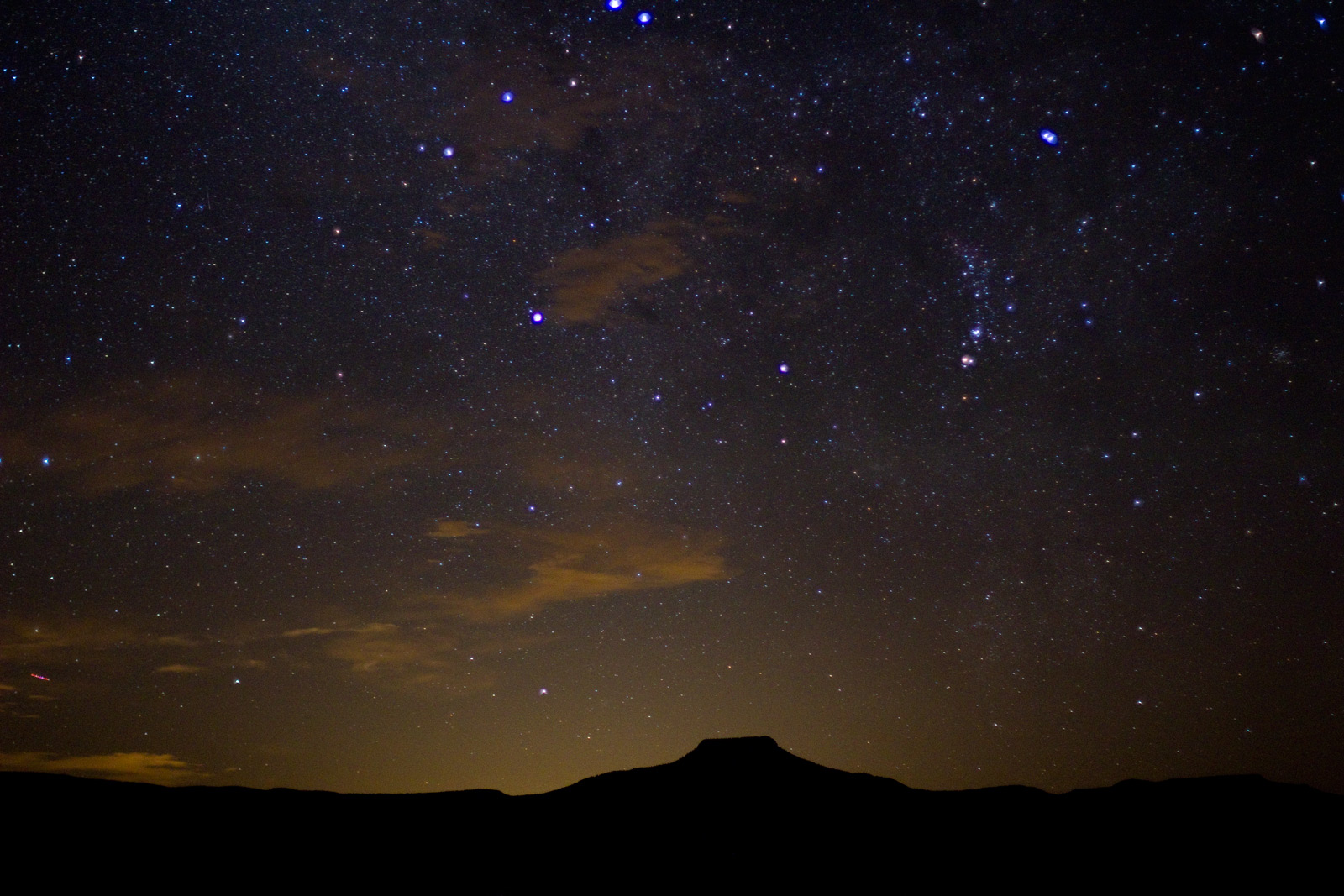
I didn't get 13, 7, 4 or even 2 incredible nights to image the heavens.  I did get some quality time on a cold rusty folding chair with views like this to keep me company.


Sunday, August 1, 2010

Storm Chasing Astrophotography

I also imaged Sagittarius with the 50mm lens and no tracking.  This was a stack of 16 10sec images at f/1.4 and ISO3200 using the same master dark frame as the Cygnus shot.  I stopped because the clouds were rolling in faster than I could take pictures.

The cloud moving through the image was illuminated by lightning in 4 of the frames giving it the feel of a new nebula moving into the neighborhood.  I think it looks kinda cool.

I have birthed a new discipline ... wide field astro/storm chaser imaging!

Hey, with good focus and some flats this might have amounted to something!

Stacking no Tracking

It might seem strange but honestly I never considered that there would a condition somewhere in between Raining Like Cats and Dogs and Darkest Skies You Have Ever Seen.  Not only is there such a condition it is by far the most likely one I am going to experience if there is any break in the seeming perpetual cloud-out.

Actually it happened last night.  It was raining at 9pm.  By chance happened to look up at 9:40pm and ... "that's a funny cloud".  Yeah.  It's commonly known as the Milky Way.  Now mind it is still partly cloudy but I was still elated to see a "poke your eye" out MW.   It takes me 20minutes to get back to our hovel and decide that it is not worth it to pull out the Astrotrac and go full-auto.  Instead I just grab the tripod, a 50mm f/1.4 lens and figure I take some short duration shots under various conditions so I can say that I at least took some kind of image of the stars.  Basically I was going out with not one piece of equipment that I so painstakingly shipped out to New Mexico.  No mind ... I'm on it.

About 45min later the sky was extinguished and the rest of the night was full of lightning and heavy rain. None-the-less I got a couple images and learned some lessons.  Lessons first - images later.

1.) The 50mm f/1.4 lens is cool (so much freaking light) but it is no red-stripe.
2.)  It is near impossible to focus at f/1.4 while looking at a live view screen.
3.)  Plop down some $$ for a nice carbon fiber tripod.  Cheapie tripods, well, lets just say some language that I wouldn't use around the girls was spoken into the night air.
4.) In a serious pinch ISO3200 will do.  A serious pinch.  Noisy but OK if you downscale.
5.) Don't panic and shoot wide open.  The lens can buy you a lot even stopped down a notch or two.
6.) Acceptable trailing is in the eye of the beholder.  My eye didn't like anything more than 10sec with a 50mm lens.
 7.) Trying to frame a shot near the zenith while mounted on a tripod is desperation in action.

Never shy to try something completely new and abandoning my detailed planning (read making stuff up on the spot) I thought I might shoot a bunch of short duration frames, shoot some darks, and try to stack 'em.  While my images look like crayola (bad focus, jumpy tripod, lens not set correctly) I think this idea has merit (I'm sure others have tried this).

So ideally one would:
1) shoot as high an iso as acceptable
2) lens as wide open as acceptable (but probably stopped down a bit)
3) turn off in camera dark frame
4) shoot a bunch of darks to bang down the noise
5) shoot flats (I didn't and wished I had)
6) stack lights with translation and rotation settings and let software take care of image shift
7) process to your hearts content

With some practice and experimentation I think some very nice wide field images could be had with no tracking mount at all.  The below is a stack of 25 10sec exposures at f/1.4 and ISO3200.  Same number of darks.  All on a static tripod - no tracking!

Cygnus near Deneb with a tiny teeny North American nebula below.  Wish I had come at least somewhere near focus and shot some flats.