Showing posts with label Widefield. Show all posts

Wednesday, September 30, 2015

YALE (no, not the University)

Yet Another Lunar Eclipse.

Usually I'm a bit more disinterested in Lunar Eclipses.  They come, they go.  The popular press and media makes a bit deal about it.  The Blood Moon Super Size Me Things Come in Threes Apocalypse.  Sigh.  And why am I so grumpy with the seemingly ever more popular characterization of "Blood Moon".   It doesn't look like blood.  It's orange.  Copper maybe.  Orange Moon or Copper Moon are much better descriptions with less drama/pseudo religious connotation.  Lunar Eclipse would be even better.  I cringe when I hear kids saying, "did you see the blood moon?"  I hope they actually understand what is happening - after all we have come a long ways in the last few thousand years.

The excitement at a "Super" lunar eclipse is also overbaked.  Last one until 2033!  Well sorry, the "Super" part is accounted by the moon being at perigee-syzygy (read closest approach in the moon's elliptical orbit).  This results in a colossal 14% or so increase in the size of the disk.  If only "Super" meant 14% bigger to McDonalds.  I'm pretty sure there is not a human on the planet than can say with any certainty that they can tell the moon is 14% bigger in apparent diameter.  So it goes.

The next full lunar eclipse around these parts (New Mexico) is in January 2018 so we've only a little more than 2 years to wait as long as you don't care about the "Super" part - which you can't see anyway.

OK rant off.  With all of the above out of the way ...

This one was real pretty.  Don't remember the last time I saw a lunar eclipse so close to the horizon. Makes for a bit more drama when you can see the eclipsed moon next to terrestrial features like mountains or cityscapes.

Eclipsed Moon over the Sandias and northern outskirts of Albuquerque NM, Sept 28, 2015
Note the traffic on I-25 streaking across the base of the Sandias.
This lunar eclipse was also a opportunity to connect with friends near and far.  Most notably with my astro-posse hanging out in the coastal hills of the San Francisco peninsula waiting pensively for a break in the clouds.  As we are an hour ahead I was able to send them updates and they in turn kept me updated on navigating crowds and clouds.  Fortunately they were rewarded with a break in the clouds with just a few minutes of totality remaining.

Clouds to the East also kept my Austin Texas pal waiting nervously.  With friends and family by his side they waited with little hope ... but towards the end of totality they did get a glimpse.  Nice thing about the eclipse is you can make what you want of it - nice excuse to get together - outside at night!

A friend in Los Gatos texted ... can't see a thing!  But I don't think they cared much as they dined on delicious food and the Raki flowed ....  People together, connecting, outside, at night.

New friends and neighbors were texting excitedly as they watched from their homes nearby.  My wife and oldest daughter joined me on the room of our patio.  We watched together as I took advantage of our clear skies and clicked off picture after picture with the camera on a tripod.

Pretty orange moon suspended in the inky dark punctuated with stars.
Mid eclipse through 200mm lens on a static tripod.
With anything much more than a 100mm lens you really need a tracking mount to get any kind of detail on the moon.  Exposure times much more than a quarter second will blur details - even with mild magnification.

I still think the best way to enjoy a lunar eclipse is in a comfy chair with no visual aids or cameras.  Just relaxing with friends and family, near or far, under the night sky.  So wonderful to begin to see stars appear and later, mid eclipse, the Milky Way.  It would be wonderful if the lunar orbit wasn't so inclined so we could enjoy a lunar eclipse every Full Moon.  If that were the case I wonder how it would have changed how the ancients viewed eclipses and if we would have stamped out the memes of evil portent long ago.

As it is we only have to wait until 2018 to do this again (at least here).  It will be another opportunity to get together with family and friends under the wonders of the night sky.  As long as that happens I guess I can live with another "Blood Moon".

Monday, April 29, 2013

Butterfly, Crescent, and Bubble

Here is my first go at a bicolor image.  It is the same field as the previous post ... I wanted both the Butterfly and the Crescent nebulas (Cygnus) in the same field.  Oh ... and this time I didn't forget my narrowband filters. Don't give me any grief about not posting this image for 7 months.  Life happens.

I chose to experiment with a more "orange" palette.  I'm sure with some more work I could figure out how to make the OIII regions (notable around the Crescent) more obvious.  Next time.

Butterfly and Crescent and ...


Now if you blow up the part of the image next to the crescent (200%) one can just barely see the Soap Bubble Nebula.   In the red box.  Arrow pointing at it.  I'll give you a moment.

See it?  Faint little guy.  It is notable since it was discovered by a amateur astrophotographer in 2007.  Now that we know where to look anybody can image it though I thought it was pretty neat to pull it out with a lil ol' 200mm Canon lens.  

... Soap Bubble


Butterfly, Crescent, and Bubble

Taken at Lake San Antonio, CA  Sept. 12-14, 2012
QSI583, Canon EF 200mm f/2.8L
Ha (3nm): 24x10min bin 1x1 @f/2.8
OIII (3nm): 24x10min bin2x2 @f/2.8
Total exposure time 8hrs
AP900 Mount
calibration, registration and post-processed in PixInsight

Thursday, August 23, 2012

Star Fire

A dark sky outing with friends to Lassen National Park in Northern California was hampered by two large forest fires in the area.  For multiple nights we dodged smoke and clouds for a glimpse through to some of the darkest skies California has to offer.  Finally on Saturday night, August 18, the smoke and clouds had abated and we drove up to the Bumpass Hell parking lot full of anticipation for a night of imaging and observing.

As we entered the Park an ominous white cloud billowed high in the West.  A new fire had started from a lightning strike only a few hours earlier.  As darkness fell the eerie glow would presage the dangerous fire that it would become over the next 48hrs.

The conjunction of Mars, Saturn and Spica (lower left) in the fiery glow of the Ponderosa Fire.  
Click on either image for a larger version where you can toggle the annotation.
The Ponderosa fire is still burning - nearing 25,000 acres with up to 50 homes and structures burned.  Evacuation warnings have gone out to the little town of Mineral where we stayed.

The fire glow over the ridge died down with the coming of night and we enjoyed a nearly perfect night of observing.  It was a very narrow window as I am sure the smoke from this fire has darkened the skies over Lassen again.

Star Fire

Taken at Bumpass Hell parking lot, Lassen Natl. Park,   August 18, 2012
Canon T2i (stock), Canon EF24 mm f1.8
Manfroto Tripod (stationary)
Mosaic of 4 frames, each 8 sec exposures @ ISO1600
no dark or flat subtraction
vignetting and lens correction in Lightroom 4
frame stitching in PTGui Pro
final adjustments and noise reduction in Pixinsight

Thursday, August 2, 2012

Pleiades Rising

Trying to make the best of a trip to New Mexico during the full moon and monsoon season.  Don't get me wrong - the skies are spectacular.  I'm just haven't learned how to best capture what I'm seeing and feeling.  I have plenty more day shots that I like but haven't decided if I want to "cross the streams" on what would otherwise be a astronomy centric blog.  If I did it would increase the rate of images I post given the glacial pace of astro-imaging this year.

Here come the Pleiades again.  click to enlarge
The moon is two days shy of full and is swinging low on the horizon about 30 degrees outside of the right side frame.  The full width is about 170 degrees but the above image is a little less than that since I cropped out my shadow which was on the left side of the frame.  Only the brightest stars are visible because of the short exposure and moonlight.  You can see the Pleiades rising just above Kitchen Mesa, the large rock face in the left hand frame.

I experimented with a number of ways to capture/process this.  It is a two frame mosaic with each frame processed with 4 different exposures using Photoshop's HDR function.  I certainly do wish for more tools in the PS HDR module but at this point I don't do enough HDR to justify a specialty package.  I stitched the two frames using PTGui Pro since PS couldn't figure out how to stitch this correctly.  After that I did some final tone/exposure/noise reduction in Lightroom.

Pleiades Rising

Taken at Ghost Ranch, NM   July 31, 2012
Canon T2i (stock), Canon EF-S 10-22mm @ 10mm  f3.5
Manfroto Tripod (stationary)
two frames, each frame with 1, 2, 4, 15 sec exposures @ ISO1600
no dark or flat subtraction
vignetting and lens correction in Lightroom 4
HDR combine in Photoshop
frame stitching in PTGui Pro
final adjustments and noise reduction in Lightroom 4

Saturday, July 30, 2011

Weather Gods Conspire

Back in New Mexico for vacation.  Started this chronicle from here just about a year ago now.  On that trip I was thwarted by cloudy skies most of the nights so this year I thought I'd ratchet down the gear requirements while also doing something that worked with the weather.  Something that would be interesting come rain or shine.

That something would be time lapse - and as I quickly discovered - full of it's own set of crazy hair shirt intricacies and rituals.  Maybe more on that later.  For now I just want to complain about the weather.

I have two simple requests of the weather gods.  I need:  1.) completely clear (night) skies for some decent astrophotography, astrolanscape photography or time lapse astrophotography -or- 2.) full on raging thunderstorms, lightning, and rain for some cool daytime timelapse.

Request denied.  It's been clear as a bell in the mornings giving way to clouds and dull overcast skies in the afternoon and evening.  No thunderstorms to mention.  A few drops of rain.  pffffffft.  So far I've been pretty much skunked for photography (but just being here is wondrous enough).

Hey at least we came a couple weeks after the states largest forest fire ever which choked the skies with smoke and haze.  A real disaster and hardship which makes my complaining seem pathetic by comparison.

So as I wait for the skies to cooperate I did manage to get one nice picture.  Hopefully many more to come.

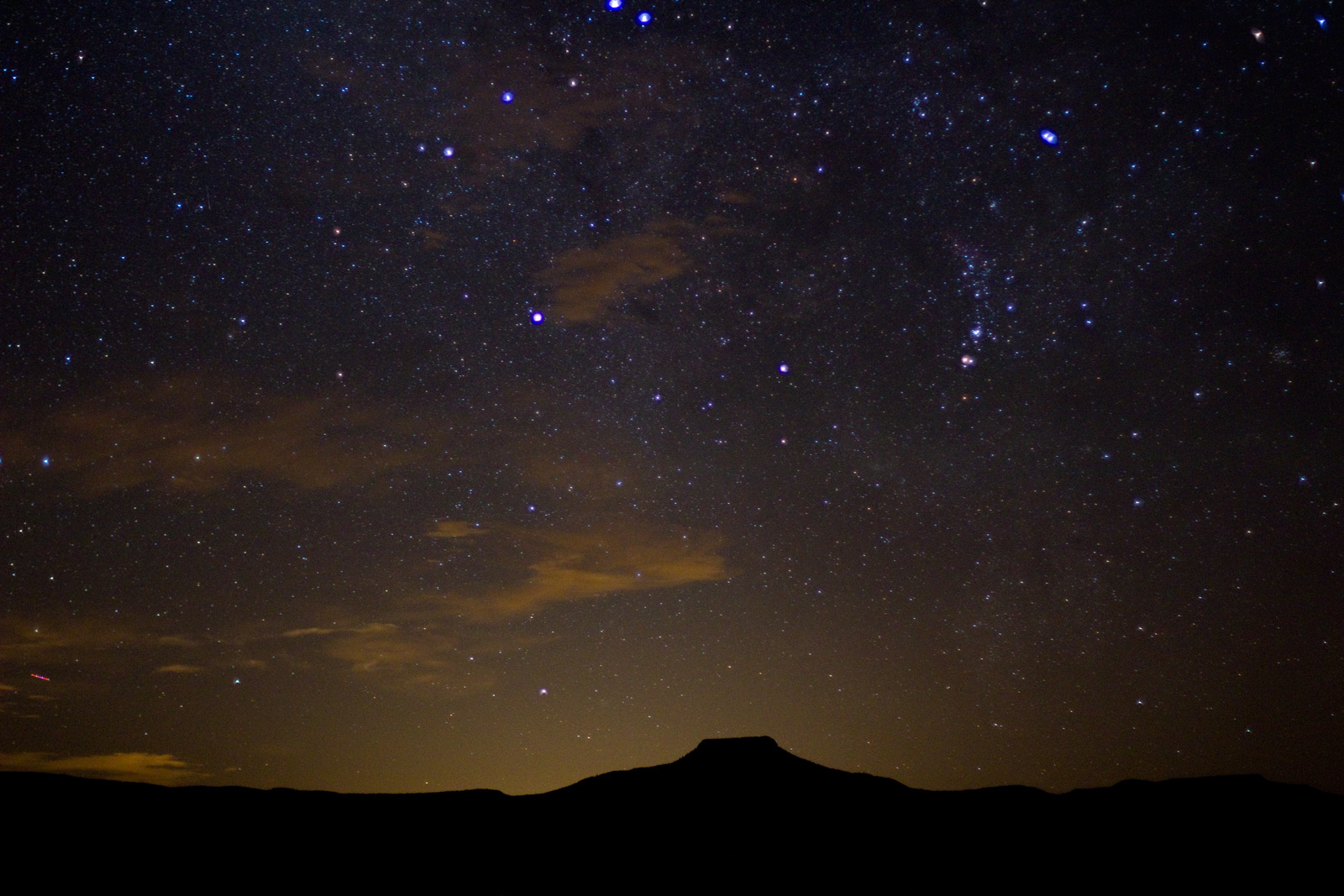
Scorpio escaping the clutches of Cerro Pedernal.


Stars over Pedernal

Taken at Ghost Ranch, NM  July 28, 2011
Canon T2i (stock), 
Canon EF 24mm f/1.4L II USM @ f/1.4
Manfrotto Tripod
5sec exposure @ ISO800

color adjusted Adobe RAW

Saturday, July 9, 2011

Montebello Summer Time Lapse

I spent the night of July 5 testing CCD gear.  I wanted to come home with more than some test frames so I set up the Canon with an interval timer and took 1hr 45min worth of images.  I started the exposures shortly after dusk at 9:30pm as the evening twilight gave way to darkness.

You can see many planes on their approach to SFO and a couple entering the frame from the right (headed south down the Pacific coast) on their way to destinations unknown.  Odd to think that each brief streak of light is a aluminum tube holding a hundred or more people.  Also visible are a couple meteors and some high clouds which briefly threatened to make it a short evening.  I also think there is a geostationary satellite in the mix.  It's a bit hard impossible to make it out in the postage stamp sized inline version that blogger provides.  You can double click on the video to see it at YouTube (HD even) but I'm also disappointed quality of the playback there.  It is very smooth in native playback on my laptop ... after upload to YouTube the playback is annoyingly jerky.  I'll have figure this one out.

Update:  Click here to watch it on flickr.  Much better.


In order to pan the field I use my Astrotrac tangent drive mounted horizontally and in "Southern Hemisphere" mode.  This causes the camera to pan opposite the earths rotation so I can get a very slow pan. You will notice near the end -  the panning stopped when the batteries died.

Montebello Milky Way

Taken at Montebello Open Space, CA  July 5, 2011
Canon T2i (stock), 
Canon EF 24mm f/1.4L II USM @ f/2.8
Manfrotto Tripod with Astrotrac mounted horizontal for pannning
398 10sec exposures @ ISO1600
,  5sec interval
no calibration, color adjusted in Pixinsight

Timelapse generated in QuickTime Player 7

Monday, January 3, 2011

Cassiopeia to Taurus

Here is another widefield taken back in October at the Calstar event.  One great thing about astrophotography is that you can take data quicker than you I can process it.  This provides endless hours of "fun" back home when the rain clouds come or the moon visits.

Of course this can be mitigated with a proper understanding of the underlying principles of detector physics and processing methodology.  Combine this understanding with a smooth efficient workflow and now you can drastically shorten the time from camera to presentable image.  I'm not anywhere near that point yet so, well, there you go.

The more I learn the more how much I realize I dont' know.  Being curious by nature (and not a little bit obsessive) this drive me nuts.  So many variables and branch points along the way.  So many ways to attack the problem and so much equipment and software tools to throw at it.  Science, hardware, software, art, wonder, ... what's not to like!

This was taken with the 10-22mm EF-S lens at 14mm and stopped down to f5 to mitigate the worst of the vignetting and corner aberrations.  My camera isn't modified to have the IR cut filter removed so the hydrogen alpha regions are muted but even so there is a hint of what lies in those star clouds.  Also evident is intersteller de-blueing (or intersteller reddening if you like) which results in stars located in the dense Milky Way arm appearing redder than they actually are .  Open clusters galore and a couple of our closest galactic neighbors.

There is even a very special guest appearance by Comet Hartley-2 which was visited by the re-missioned Deep Impact (EPOXI) probe not long ago.  Here is a extra credit question for the nerds out there.  Can you guess the date the image was taken by the location of the comet?  Answer below in the image info.  We'll see Hartley-2 again in 2017 as he continues his rounds of the solar system.

Cassiopeia to Taurus.  Click image to see at full res.  Click here for flickr.
If you want to see a version without yellow text all over the place click here.

I have a couple more widefields yet to process along with a couple hours of M33 data sitting in a unopened folder.  Moon?  Rainclouds?  I can get my astronomy fix with or without you!

Taken at Lake San Antonio, CA  October 9, 2010
Canon T2i (stock), Canon EF-S 10-22mm @ 14mm  f5
Astrotrac Travel System Mount
33 120sec exposures @ ISO1600
128 dark frames from my library
no flatfielding, vignetting and gradients removed in PixInsight
128 bias frames
calibration, registration and post-processed in PixInsight

Thursday, December 16, 2010

North and Up ... Now with Roadmap!

Here is an annotated version of the wide field below showing constellations and some of the brighter and most obvious objects.  If you pixel peep you can find much more especially since we are in open cluster central.  But I think the image is best appreciated when taken in all at once.

click for larger version

Tuesday, December 14, 2010

North and Up

I like widefields.  This probably stems from my enjoyment of gigapanning which I dabbled in before falling into this astro imaging black hole.  I like the perspective and the framing possibilities of a nice wide vista.

I already have a 100mm EF-L lens but found myself wanting even more reach.  I got it in my head that it would be cool to frame M31 and M33 in the same field.  I thought the 100mm would be able to do it but after a valiant attempt (laying in the dirt making adjustments while looking at the camera back) to squeeze them both into the opposite corners of the frame ....  Oh, so close but no-go.  And about a week later after Rogelio Andreo put up this image of just the conceptual frame I imagined.  He did it with a 3x4 mosaic'd panel (and considerably more skill and artistry than I would have!).  Incredible and inspiring but my skills are not up to trying a mosaic panel just yet.

So a few days before CalStar last October I ordered a 10-22mm EF-S lens.  Yeah, a bit overboard but I wanted the lens for terrestrial imaging as well.  I wanted wide ... lets go wide!

But Robert Burns knew how this would turn out.

The best-laid schemes o' mice an' men
Gang aft agley,
An' lea'e us nought but grief an' pain,
For promis'd joy !


I like the lens for terrestrial photos.  It is ... fun.  It's a good lens, not a great lens, but actually fun to use.  But as we know, a good lens, even a fun lens does not a good lens for astro imaging make.  I knew there would be aberrations at the edges of the field but there was more than I expected.  Oh, focusing.  Don't even get me started.  What a pain.  No camera back focusing here.  I had to connect to a computer and do a live view focus on jupiter just to see anything.

And then the vignetting.  Lots of it.  Flat fields that look like driving through a tunnel.  OK, a bit of an exaggeration but still.  And no sky flats possible with a field as wide as that.  I took much more time trying to get a decent flat frame than I did getting the actual images.  Much more.  In the end I took my flats off my laptop screen.

After all that ... calibrating with my flats made the images worse.  I'm still trying to puzzle that one out.  The flats severely over corrected the vignetting.  I dunno ... only thing I can think of is that my flats were not representative some how.  Something to figure out.

So after wrestling with flatfielding I decided to only calibrate with darks and bias frames and deal with the gradients in PixInsight which has some powerful tools to throw against it.  I tried a bunch of background models and finally stumbled into one that was "good enough".

Cassiopeia nearly centered.  That's Deneb and the North American nebula at left.  Andromeda upper center. And a zillion stars from the Milky Way. Click image for larger version or here for flickr.

Of course the tree was out of the field when I started but slowly crept in during the hour I was taking the images (in the end I only used 10 of the 30 2min exposures I took).  During star alignment that tree area becomes a blurry mess so I just pasted the tree from the last frame in place.

There is a lot in there.  Double cluster right of center.  M31 mid top and if you look on a larger version you will find M33 just near the top of the frame to the right of M31  (yes, by design ... I got my wish).  I should work on an annotated version some cloudy, rainy night.

So, more lessons learned.  Maybe I should have spent the time learning to put mosaics together after all.  But there is something kind of neat about this field of view.  When I was taking the images I noticed that the field was an approximation of what you see with the unaided eye.  Plus or minus.  Look North and Up and that is what you would see ... if your eye could integrate photons.

North and Up

Taken at Lake San Antonio, CA  October 9, 2010
Canon T2i (stock), Canon EF-S 10-22mm @ 14mm  f5
Astrotrac Travel System Mount
10 120sec exposures @ ISO1600
10 darks
no flatfielding, vignetting and gradients removed in PixInsight
32 bias frames
calibration, registration and post-processed in PixInsight

Friday, September 17, 2010

Lost in the Clouds

Well I pretty much buried M11 (Wild Duck cluster) in the starcloud. It's flying around in there towards the center of the frame. Yes, there.  The white splotch in the center.

I took 71x1min of data which yes, might have been over doing it a bit.  Processed to stretch the contrast between the the starcloud and Barnard's little dark nebulas. Along the way the Wild Duck kinda got lost in the fog. Oh well.

Scutum Starcloud
I've stared at this image for quite some time now and as much as I try to make myself like it ... I just don't. All the standard imager excuses apply (focus soft, tracking could have been better, star bloat, blah blah blah) but that isn't it.  Not really.

I've noticed that I develop an affinity for some images ... despite various flaws. Others are like shirts kept in the closet and rarely worn. Not the garish colored ones or those that "must have shrunk in the wash".   I mean the ones with nothing wrong per se ... just something not quite right and they are passed over again and again.

I showed this image to a friend and his jaw dropped. "You mean that is in the Milky Way? That golden carpet is, like, stars? Every dot? And what is that way cool dark stuff?  Your joking ... really?  That's mind blowing."  When I looked at it through his eyes I started to appreciate it more and more.  I still don't like it much but it sure made a huge difference to see the wonder on my friends face.

Maybe there is a shirt or two in my closet that deserves another chance.


Scutum Starcloud

Taken at Montebello Open Space Preserve, CA Sept. 4, 2010
Canon T2i (stock), 100mm EF-L @ f3.5
Astrotrac Travel System mount
Imaging temperature: 65F ambient, 29C-33C in-camera sensor temp
71 60sec exposures @ ISO1600
64 darks (sensor temps 29-33C to match imaging temp range)
21 flats (1/5sec ISO 100) 21 flatdarks
pre-processed and stacked in Nebulosity
post-processed in PS4

Saturday, September 4, 2010

The First is Last

This is the last of the images from our 2010 trip to New Mexico.  I just realized that this picture of the southern Milky Way ...

[south from this latitude anyway - would be amazing to see this at the zenith! note to self, must travel with gear south of the equator]

... was the very first of the trip way back on August 3rd.  I remember being so excited to finally have a break in the monsoon storms.  I waited about 9 days for that.  It was still cloudy that night and I shot 16 60sec exposures before the clouds came charging through.  It was first light for the 100mm EF-L lens - I hadn't even taken a terrestrial shot with it yet.  Still had that, ahhhh, new lens smell.

Old Friends.  click to flickr
Only 16min of data but it probably would have taken me an hour to pull out this signal from the skyglow back home.

There is the Trifid and Lagoon floating in the shoals of their inky pool.  The globular cluster M28 off to the left looking almost star-like in this wide field.  Thousands of stars masquerading as one.  The open cluster M23 sparkling jewel like, just peeking into the frame in the upper right.  The comfort of old friends revisited. 

Taking a picture of this area is like photographing Half Dome in Yosemite - standing next to hundreds of tourists all pointing their cameras at the amazing vista. One of the most photographed areas of the sky.  Iconic. You have seen hundred of pictures.  You have seen it dozens of times with your own eyes.  Yet you are drawn to take yet another picture as a keepsake of this particular meeting.  You almost have to.

In the end 3 partial nights dodging clouds and moving from object to object.  I had one perfect night when I snagged an hour each of M33 and M32 before the moon rose.  Six images.  Hours and hours of processing images late into the night after returning home.  Simply perfect.

But now I'm out of data.  Must. Get. More.   Hmmm,   It's been about a month.  Dark moon cycle.  Hey Marek ... wanna go to Montebello tonight and shoot some stars?  I'm in!

Southern Milky Way
Taken at Ghost Ranch near Abiquiu, New Mexico August 3rd, 2010
Canon T2i (stock), 100mm EF-L @ f3.2
Astrotrac Travel System mount
Imaging temperature range: 60-62F
16 60sec exposures @ ISO3200
50 darks, 20 flats (1/5" ISO 100) 20 flatdarks
pre-processed and stacked in Nebulosity
post-processed in PS4

Saturday, August 28, 2010

Broken chips at the bottom of the bag

I'm absolutely craving some potato chips.  Ruffles would be nice but I wouldn't be picky.  We usually don't keep potato chips in the house, and it is well after 12:30am, so I don't think there are any in my immediate future.

I was finishing up this image when I started to think about potato chips and I made a connection (ok, so cut me some slack - it's 12:38am Saturday night after a looooong work week).   I'm down to the crumbs at the bottom of the bag with the remaining images from my trip to New Mexico.  Flawed yet still flavorful.  I won't be embarrassed - I'm reaching in and licking my fingers.

This image of M16, M17 was taken on the very first night I had *any* clear skies.  I took 35 images before I was clouded out.  In the end I only had 18 minutes of usable sub-frames.  It was also the first image with my 100mm lens and I didn't quite hit focus - I was in a rush because of the clouds.  Pity.

I really like these wide fields.  Might have something to do with having done so much visual astronomy over the years where a 1 degree field is HUGE.  This image is like 7x10 degrees.

A forest for the trees kind of thing.  It looks much nicer if you click the image to get the full crop.


A forest full of stars.
 
M16, M17 region
Taken at Ghost Ranch near Abiquiu,  New Mexico August 3rd, 2010
Canon T2i (stock), 100mm EF-L @ f3.2
Astrotrac Travel System mount
Imaging temperature range:  61F
18 60sec exposures @ ISO3200
60 darks,  28 flats (1/5" ISO 100) 30 flatdarks
pre-processed and stacked in Nebulosity
post-processed in PS4

Sunday, August 8, 2010

Expectation Management

hmmmm ... now that didn't quite go as anticipated.  I look at the date of the last post and it was a full 8 days ago.  Storms, aging hardware and people not quite so sure how to cycle a router (or if they should even trust a guy who looks like he just wandered in from the outback to do it) all conspired to keep me off the net.

So here it is a full week later and we have arrived back home.  Home where the signal is strong and bandwidth abundant.  Somehow the trade doesn't seem even.

No, my heart is still on that mesa.  Sitting on a cold folding chair, my tracking mount and camera ready for any break in the clouds.  Hours out there.  Everyone else asleep.  Hour after frustrating hour.

I loved every minute of it.

I was talking to a woman while waiting in line for lunch a few days ago.  She was relaying her disappointment of a hike canceled due to lightning but instead she got to spend a few hours connecting and talking with her grand daughter while watching the weather pass.  Understanding, I told her that Ghost Ranch is all about "expectation management".  She said "oh, I have the remember that ..." and pulled out a pen and began scribbling in a notepad.  Having someone write down something I say at a place where world famous writers, poets and artists hang out was amusing to say the least.  But the more I thought about it the more I could see it for myself.

I didn't get 13, 7, 4 or even 2 incredible nights to image the heavens.  I did get some quality time on a cold rusty folding chair with views like this to keep me company.


Sunday, August 1, 2010

Storm Chasing Astrophotography

I also imaged Sagittarius with the 50mm lens and no tracking.  This was a stack of 16 10sec images at f/1.4 and ISO3200 using the same master dark frame as the Cygnus shot.  I stopped because the clouds were rolling in faster than I could take pictures.

The cloud moving through the image was illuminated by lightning in 4 of the frames giving it the feel of a new nebula moving into the neighborhood.  I think it looks kinda cool.

I have birthed a new discipline ... wide field astro/storm chaser imaging!

Hey, with good focus and some flats this might have amounted to something!

Stacking no Tracking

It might seem strange but honestly I never considered that there would a condition somewhere in between Raining Like Cats and Dogs and Darkest Skies You Have Ever Seen.  Not only is there such a condition it is by far the most likely one I am going to experience if there is any break in the seeming perpetual cloud-out.

Actually it happened last night.  It was raining at 9pm.  By chance happened to look up at 9:40pm and ... "that's a funny cloud".  Yeah.  It's commonly known as the Milky Way.  Now mind it is still partly cloudy but I was still elated to see a "poke your eye" out MW.   It takes me 20minutes to get back to our hovel and decide that it is not worth it to pull out the Astrotrac and go full-auto.  Instead I just grab the tripod, a 50mm f/1.4 lens and figure I take some short duration shots under various conditions so I can say that I at least took some kind of image of the stars.  Basically I was going out with not one piece of equipment that I so painstakingly shipped out to New Mexico.  No mind ... I'm on it.

About 45min later the sky was extinguished and the rest of the night was full of lightning and heavy rain. None-the-less I got a couple images and learned some lessons.  Lessons first - images later.

1.) The 50mm f/1.4 lens is cool (so much freaking light) but it is no red-stripe.
2.)  It is near impossible to focus at f/1.4 while looking at a live view screen.
3.)  Plop down some $$ for a nice carbon fiber tripod.  Cheapie tripods, well, lets just say some language that I wouldn't use around the girls was spoken into the night air.
4.) In a serious pinch ISO3200 will do.  A serious pinch.  Noisy but OK if you downscale.
5.) Don't panic and shoot wide open.  The lens can buy you a lot even stopped down a notch or two.
6.) Acceptable trailing is in the eye of the beholder.  My eye didn't like anything more than 10sec with a 50mm lens.
 7.) Trying to frame a shot near the zenith while mounted on a tripod is desperation in action.

Never shy to try something completely new and abandoning my detailed planning (read making stuff up on the spot) I thought I might shoot a bunch of short duration frames, shoot some darks, and try to stack 'em.  While my images look like crayola (bad focus, jumpy tripod, lens not set correctly) I think this idea has merit (I'm sure others have tried this).

So ideally one would:
1) shoot as high an iso as acceptable
2) lens as wide open as acceptable (but probably stopped down a bit)
3) turn off in camera dark frame
4) shoot a bunch of darks to bang down the noise
5) shoot flats (I didn't and wished I had)
6) stack lights with translation and rotation settings and let software take care of image shift
7) process to your hearts content

With some practice and experimentation I think some very nice wide field images could be had with no tracking mount at all.  The below is a stack of 25 10sec exposures at f/1.4 and ISO3200.  Same number of darks.  All on a static tripod - no tracking!

Cygnus near Deneb with a tiny teeny North American nebula below.  Wish I had come at least somewhere near focus and shot some flats.